
You are halfway through a sentence and your fingers freeze. Is it “peice” or “piece”? That tiny pause can throw off an entire email, and if you guess wrong, a spell checker will flag it red before you even hit send. Here is the fast version:
“piece” is c orrect, and “peice” is not a real word at all.
Quick Answer
The correct spelling is “piece.” It follows the classic “i before e” pattern, so the letters run p-i-e-c-e. “Peice” reverses that order and is considered a spelling error in every dictionary, style guide, and grammar checker in use today.
| Don’t Miss These Articles |
| OTP Meaning: What Does OTP Stand For? Discover It Now |
| WS Meaning: Discover What It Really Means Today |
Simple Background
“Piece” entered English through Old French, where it was already spelled “piece” and carried a similar meaning: a portion or fragment of something whole. English borrowed thousands of French words after the Norman Conquest, and this was one of them.
Because the word kept its French spelling almost untouched, it still looks a little different from words that grew up purely within English. That French root is actually the reason so many people second guess the letter order today.
Clear Explanation of the Difference
What is “Piece”?
“Piece” is a noun meaning a part, section, or single unit of something larger. You can have a piece of pizza, a piece of furniture, or a piece of good news. It is one of the most commonly used nouns in the English language.
What is “Peice”?
“Peice” is not a word. It carries no meaning, no definition, and no dictionary entry. It exists only as a typo, created when someone swaps the “i” and the “e” while writing quickly.
What Does “Piece” Actually Mean?
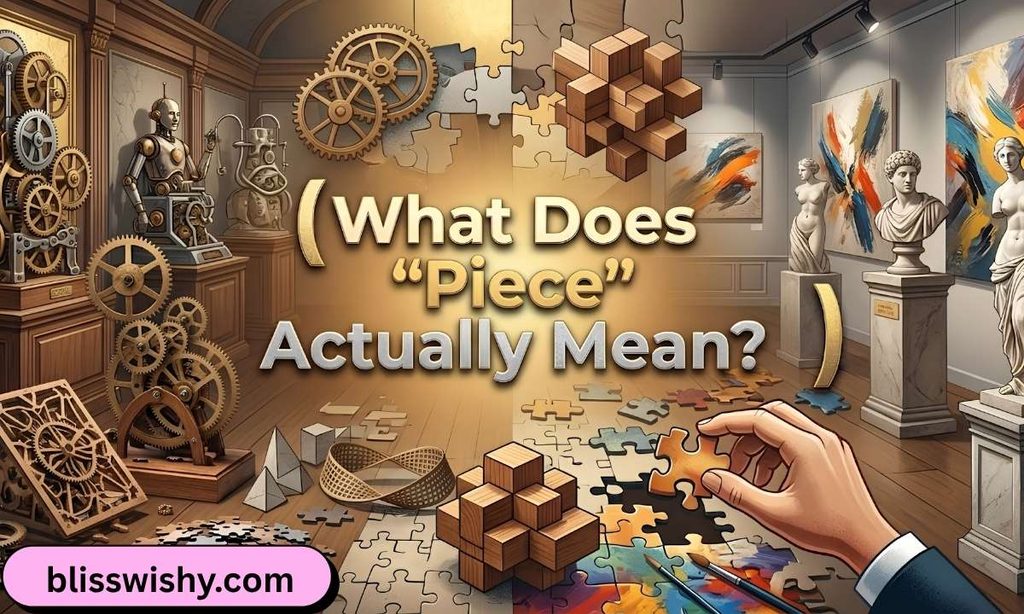
Beyond the dictionary basics, “piece” stretches across a surprising number of everyday situations. It can describe:
- A physical fragment, like a piece of glass
- A portion of food, like a piece of toast
- An abstract unit, like a piece of advice
- A creative work, like a piece of music or a news piece
- A game object, like a chess piece
Seeing how flexible the word is helps explain why it shows up in conversation so often, and why getting the spelling locked in actually matters.
Comparison Table
| Feature | Piece (Correct) | Peice (Incorrect) |
| Spelling | P-I-E-C-E | P-E-I-C-E |
| Found in dictionaries | Yes | No |
| Follows “i before e” rule | Yes | No |
| Passes spell check | Yes | Never |
| Used in professional writing | Yes | No |
| Common cause of the error | N/A | Letters typed in the wrong order |
Which One to Use and When
The answer here is refreshingly simple: use “piece” every single time, in every context, whether you are writing a text message, a résumé, or a novel. There is no formal versus informal split, no regional variation, and no exception that makes “peice” acceptable.
Simple tip to remember
Picture the word “pie” sitting inside “piece.” Both start with the exact same three letters, p-i-e. If you can spell “pie,” you already know how the first half of “piece” is built.
How to Spell “Piece” the Right Way

Break the word into its six letters and say them slowly: p, i, e, c, e. Notice that “i” always comes before “e” here, since there is no “c” sitting directly in front of the “ie” combination.
This is a textbook case for the old classroom rhyme, “i before e, except after c.” Because the “c” in “piece” comes after the “ie” pair, not before it, the standard rule applies cleanly, and the correct order is easy to predict once you know where to look.
Common Mistakes People Make
1. Reversing the letters
The single biggest cause of this error is simply typing the “e” before the “i.” It usually happens fast, without a second glance, especially on a phone keyboard.
2. Forgetting spelling rules
Plenty of people learned “i before e, except after c” years ago and then let the rule slip once autocorrect started doing the heavy lifting for them.
3. Typing too fast
Speed is the enemy here. Quick texts, rushed emails, and fast social media captions are where “peice” shows up most often, simply because there is no pause to double check.
Is “Peice” Used Anywhere?

Searches for phrases like “peice of art” or “peice movie” show up online fairly often, but that does not mean the spelling becomes correct in those contexts. These are simply common misspellings of “piece of art” or a movie title that includes the word “piece.”
No dictionary, publisher, or official source recognizes “peice” as a valid spelling variant, regardless of the subject matter attached to it. If you see “peice” used anywhere, including in a business name or informal caption, it is still a typo, just one that slipped past editing.
Is “Peice” a Word?
No. “Peice” is not a word in any English dictionary, past or present. It has no definition of its own and functions purely as a misspelling of “piece.” If a spell checker does not flag it, that is worth double checking, since some checkers miss less common typos.
Everyday Real-Life Examples
In emails
“Please find the missing piece of the contract.” Business writing has no tolerance for spelling slips, and this word shows up in professional messages constantly.
In messages
“Can you grab me a piece of that cake before it’s gone?” Texting is casual, but a misspelled common word still tends to stand out, even in a quick message to a friend.
On social media
“New piece up on the blog today, go check it out!” Content creators use this word constantly to describe articles, songs, and videos, so getting it right matters for credibility.
In daily life
“He handed her the last piece of the puzzle.” Everyday conversation is full of this word, from board games to home repairs to casual storytelling.
Short Learning Section for Students
Step 1: Learn the correct spelling
Start by simply reading the correct order out loud a few times: p, i, e, c, e. Repetition builds familiarity faster than most people expect.
Step 2: Practice
Write the word five times on paper or in a notes app without looking at a reference. This kind of active recall works far better than passively rereading it.
Step 3: Use memory trick
Remember that “pie” hides inside “piece.” That visual connection sticks in memory much longer than the spelling rule alone.
Step 4: Check your writing
Before sending an important email or assignment, scan specifically for this word. A quick, targeted check catches mistakes that a general reread often misses.
Frequently Asked Question
Is it spelled peice or piece?
“Piece” is the correct spelling. “Peice” is a common misspelling caused by reversing the “i” and “e,” and it has no valid use in English.
What is called a piece?
A piece is a portion, section, or single unit of something larger, such as a piece of cake, a piece of furniture, or a piece of writing.
Is it “1 piece” or “1 pieces”?
“1 piece” is correct. Singular numbers pair with the singular noun, so no “s” is added.
Which is correct: “2 piece” or “2 pieces”?
“2 pieces” is correct. Any number greater than one requires the plural form of the word.
Conclusion
“Piece” is the only spelling that belongs in your writing, and “peice” is simply a reversed version that never earned a place in the dictionary. The word traces back to Old French, follows the familiar “i before e” rule, and shows up in nearly every part of daily life, from puzzles to paychecks to song titles.
Once you picture “pie” tucked inside the word, the correct order becomes second nature, and that small mental trick is often all it takes to spell it right every time.

BlissWishy.com is a simple and friendly website created by James, dedicated to sharing heartfelt wishes, blessings, and meaningful messages for every special moment. From birthdays to daily inspiration, the site offers easy-to-read content that helps people express love, positivity, and joy in a thoughtful way.









1 thought on “Peice or Piece? Discover the Correct Spelling Fast!”