
Typing out a sentence about a conversation and freezing on whether to write “say” or “said” is one of those small grammar moments that trips up even confident writers. The confusion around say vs said usually comes down to tense, present versus past, but the pronunciation and irregular spelling add another layer on top of that.
Here’s the short version: say is present tense, said is past tense and past participle, and this guide walks through exactly when each one belongs.
Quick Answer ” Say vs Said “
Say is the present tense form, used for something happening now or in general statements, as in “I say what I mean.” Said is both the simple past tense and the past participle, used for something that already happened, as in “she said hello” or “they have said nothing about it.”
Simple Background
Say comes from Old English “secgan,” a verb with deep Germanic roots shared across many related languages, including Old Norse, Old Frisian, and Old High German, all of which had their own versions of this same core verb. Said developed as an irregular past tense form centuries ago, changing both its spelling and pronunciation rather than simply adding “-ed” the way regular verbs do. This shift happened gradually over Middle English, as the pronunciation of “sayed” naturally smoothed out in speech until it settled into the shorter “said” we use today, with the spelling eventually catching up to match that spoken change.
This kind of pronunciation driven spelling shift wasn’t unique to say. Several other extremely common English verbs, including “have” (had), “make” (made), and “lay” (laid), went through similar compressions over the centuries, where frequent everyday use gradually wore down the spoken form until it no longer matched the expected regular pattern. Say and said are simply one of the more noticeable examples still in daily use today, since the vowel sound changes so completely between the two forms.
said past tense
Said functions as the simple past tense of say, describing something spoken at a specific point in the past that’s already finished. “She said she’d be here by noon” places the speaking action clearly in the past, with no helping verb required to make the sentence complete.
Clear Explanation of the Difference
Once you separate these two words by tense, the confusion mostly disappears, since each one has one clear job to do in a sentence.
What is “Say”?
Say is the base form, used for present tense statements, commands, and infinitive constructions. “I say we leave early” and “don’t say that in front of your grandmother” both use say without describing anything that’s already happened.
Say past tense and past participle
This is where say gets genuinely irregular, since both the past tense and the past participle share the exact same form, said. Unlike verbs that have three distinct principal parts, say only needs two: say for present, said for everything in the past, whether standing alone or paired with a helping verb.
past form of say
To put it plainly, there’s only one past form of say, and that’s said. There’s no separate word for simple past versus past participle here, which actually makes say slightly easier to master than irregular verbs like “bite” or “eat,” since you only need to memorize one exception instead of two.
What is “Said”?
Said covers both simple past tense, standing alone, and past participle, paired with has, have, or had. “He said nothing” uses simple past. “He has said the same thing three times this week” uses said as a past participle instead, following the helping verb “has.”
Say vs said sentences
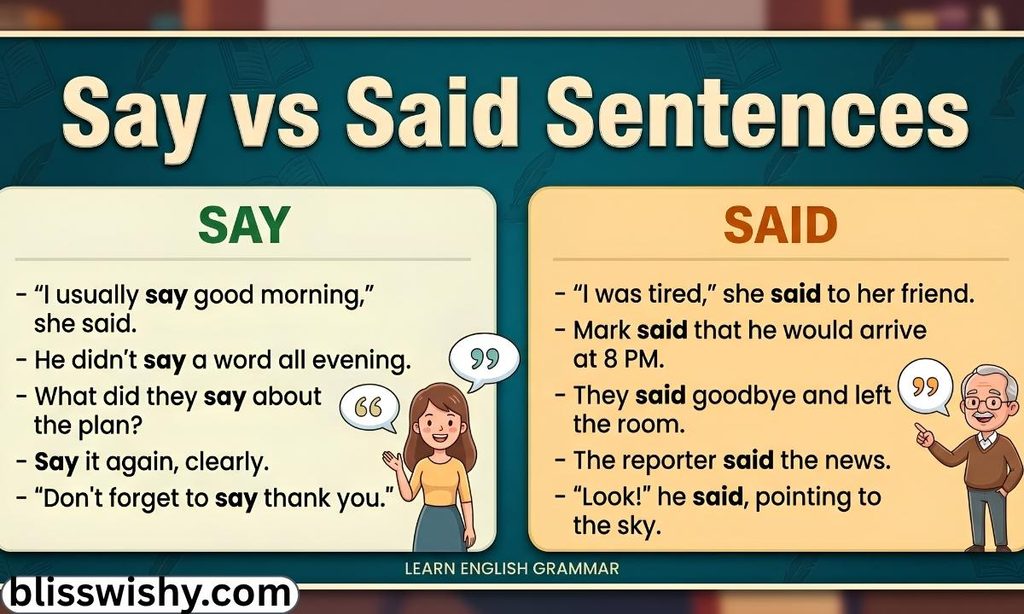
Seeing both words in complete sentences side by side makes the pattern click faster than any rule alone. Present tense: “I say this every year, but I mean it this time.” Past tense: “I said this every year, and I meant it every time.” Notice the entire sentence shifts from present to past just by swapping that one word.
Comparison Table
| Feature | Say | Said |
| Tense | Present | Past tense and past participle |
| Needs helping verb | No | Only for past participle use |
| Pronunciation | Rhymes with “day” | Rhymes with “bed” |
| Example | I say hello every morning | I said hello this morning |
| Third person singular | Says | Said (unchanged) |
Which One to Use and When
Choosing between these two words comes down entirely to when the speaking happened relative to right now.
Use say for something happening in the present, a general truth, or an instruction. Use said for anything that already happened, whether it’s standing alone in simple past tense or paired with has, have, or had as a past participle.
Simple Tip to Remember
If you can swap in “right now” and the sentence still makes sense, use say. If the action clearly already happened and is finished, use said. “I say it’s a good idea” happens now, while “I said it’s a good idea” already happened.
say past participle form
Since say and said share their past participle form, you never need a separate word here. “The witness has said the exact same story twice” uses said correctly as the past participle, paired with “has,” without needing any additional or different spelling.
Common Mistakes People Make
Most mistakes with say and said come from applying regular verb rules to a word that simply doesn’t follow them.
1. Saying “sayed”
This is the single most common error, and it happens because most English verbs just add “-ed” for past tense. Say is irregular, so “sayed” never appears in any standard dictionary, no matter how natural it feels while typing quickly, especially for English learners coming from languages with more predictable verb conjugation.
said present form
There’s no separate present form for said, since said only exists in the past tense and past participle. If you need present tense, you go back to say, or says for third person singular, as in “she says” rather than “she saids,” which isn’t a real word at all and never appears in standard English writing.
2. Using present tense for past actions
Writers sometimes default to say even when describing something that already happened, especially in casual storytelling or spoken retellings. “So then he say to me, ‘that’s not what happened'” should actually be “so then he said to me,” since the story is describing a past event, even though this slip is extremely common in relaxed, conversational speech.
Said pronunciation
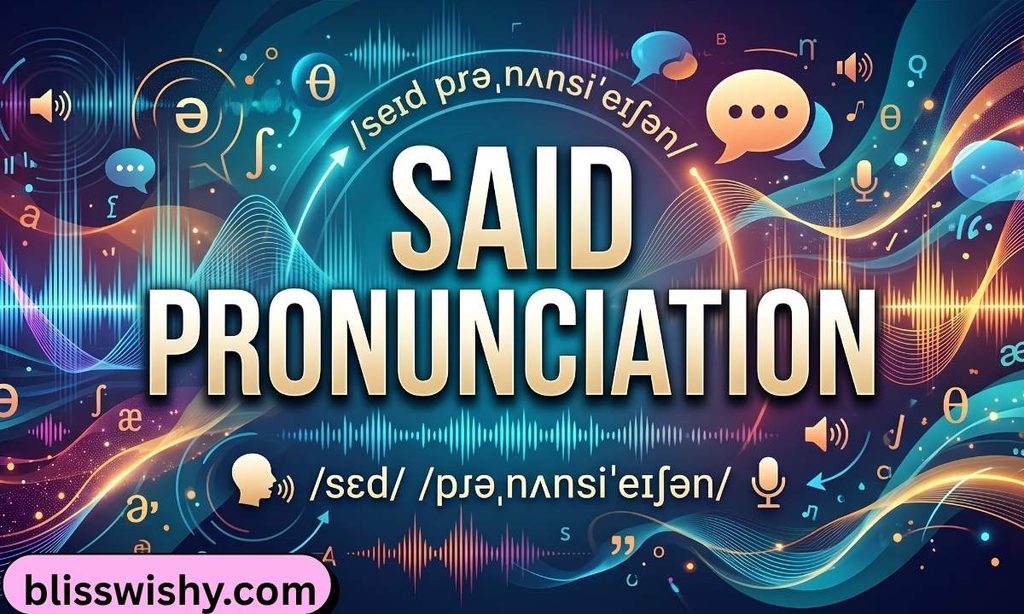
Said is pronounced with a short E sound, rhyming with “bed,” “red,” and “fed,” written phonetically as /sɛd/. This trips up a lot of people because it looks like it should rhyme with “paid” or “laid,” following the usual pattern for words ending in “aid.” Said breaks that visual expectation entirely, which is part of why the spelling feels so unpredictable the first few times you encounter it.
Say vs said grammar
Grammatically, say functions as the base form and present tense form, while said covers both simple past tense and past participle duties. This means said pairs correctly with has, have, or had, the same way any past participle would, while say never pairs with those helping verbs in a grammatically correct sentence.
3. Forgetting irregular verb forms
Say belongs to a group of English verbs that change dramatically between tenses instead of simply adding “-ed,” and forgetting this irregular status leads directly to mistakes like “sayed” or awkward tense mixing within the same sentence or story.
Say vs said examples
A few more side by side examples help lock in the distinction. Correct present: “Teachers often say practice makes progress, not perfection.” Correct past: “My teacher said the exact same thing during our last class.” Both sentences carry a similar message, but only the tense of the speaking verb changes based on when the statement happened.
Say meaning ” Say vs Said “
Say means to express something out loud using words, whether that’s a statement, a question, an opinion, or an instruction. It can also mean to indicate or suggest, as in “the clock says three o’clock,” where nothing is literally speaking but the meaning still carries the sense of expressing information.
Everyday Real Life Examples ” Say vs Said “
Seeing say and said used naturally across different everyday situations makes the tense distinction far easier to remember.
In School
“The teacher said the test would cover chapters four through six.”
In Daily Life
“My mom always says breakfast is the most important meal of the day.”
In Messages
“He said he’d be here by six, but that was two hours ago.”
On Social Media
“People say this restaurant has the best tacos in town, and honestly, they’re right.”
Say and said examples
To reinforce this one more time with a slightly different angle: “I say this with love, you need to clean your room” uses present tense for a statement happening right now. “I said this with love last week, and nothing has changed” shifts the exact same sentence structure into the past, showing how naturally the tense shift plays out in real conversation.
Short Learning Section for Students ” Say vs Said “
Breaking this irregular verb down into small, repeatable steps makes the difference between say and said far easier to apply under pressure.
Step 1: Learn the forms ” Say vs Said “
Memorize the core set: say for present tense, said for both past tense and past participle, says for third person singular present, and saying for the present participle form.
Step 2: Practice ” Say vs Said “
Write four sentences, two using say for something happening now, and two using said for something that already happened, whether standing alone or paired with a helping verb.
Step 3: Use memory trick ” Say vs Said “
Picture a clock: say points to right now, said points backward to something already finished. If the action is still happening or hasn’t happened yet, say stays in present tense.
Step 4: Practice speaking aloud ” Say vs Said “
Read your practice sentences out loud, paying close attention to whether said actually rhymes with “bed” rather than “paid.” Hearing the correct pronunciation reinforces the spelling far better than reading silently.
Said meaning
Said, in addition to functioning as the past tense of say, can also work as an adjective in formal or legal writing, meaning “previously mentioned,” as in “the said contract shall remain valid for twelve months.” This usage is far less common in everyday conversation but shows up frequently in legal documents, contracts, and formal reports.
Frequently Asked Question
How to use say and said?
Use say for present tense statements and general truths, and said for anything already spoken in the past, whether standing alone or paired with has, have, or had. A quick mental check for right now versus already finished settles nearly every case.
When I say or said?
Use “I say” when describing something happening now or a habitual action, like “I say this every year.” Use “I said” for a specific instance that already happened, like “I said that yesterday.” The tense of the rest of your sentence usually confirms which one fits.
Is it you say or you said?
Both are correct depending on tense. “You say” describes something happening now or generally true, while “you said” describes something already spoken in the past. Neither is inherently more correct, since the right choice depends entirely on the timing of the sentence.
What is correct, says or said?
Says is the third person singular present tense form, used with he, she, or it, as in “she says.” Said is the past tense form used across all subjects, as in “she said” or “they said,” and it never changes based on who is doing the speaking.
Conclusion
Say and said aren’t really two competing words, they’re the same verb doing two different jobs depending on when the speaking happened. Once you connect say to right now and said to something already finished, the choice becomes automatic, even with an irregular verb this old still tripping up plenty of confident writers along the way.

BlissWishy.com is a simple and friendly website created by James, dedicated to sharing heartfelt wishes, blessings, and meaningful messages for every special moment. From birthdays to daily inspiration, the site offers easy-to-read content that helps people express love, positivity, and joy in a thoughtful way.









1 thought on “Say vs Said: Learn the Key Difference & Use Them Right”