Typing an email and pausing halfway through a sentence because you’re not sure whether to write “advise or advice” is one of the most common little stumbles in professional writing. Both words look and sound almost identical, and mixing them up in a client email or school paper can make a confident sentence suddenly look unsure of itself. Here’s the short version of advise or advice:
one is a verb, one is a noun, and this guide makes the difference permanent in just a few minutes.
Quick Answer
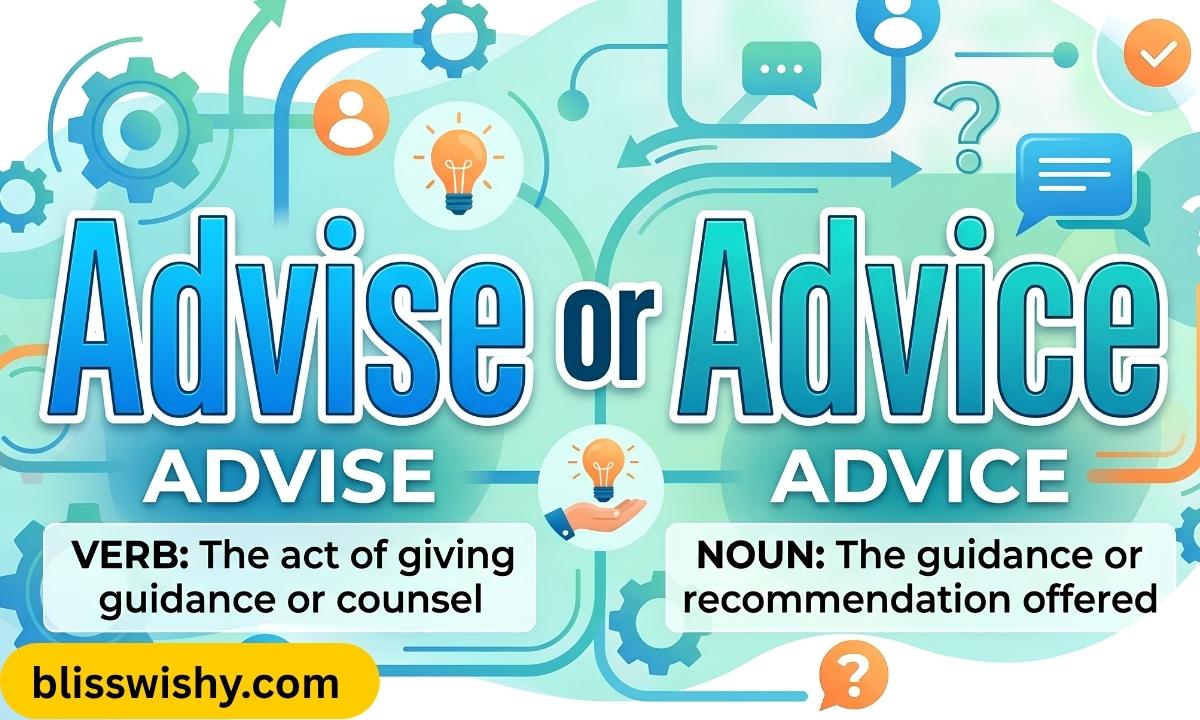
Advise is a verb, meaning to give guidance or recommend something, as in “I advise you to wait.” Advice is a noun, meaning the guidance itself, as in “thanks for the advice.” If you can replace the word with “recommend,” you need advise. If you can replace it with “guidance” or “suggestion,” you need advice.
Simple Background ” Advise or Advice “
Both words trace back to the Old French term “avis,” meaning opinion or judgment, which itself came from Latin roots related to viewing or considering something carefully. English borrowed both the noun and verb forms from French during the medieval period, and over time, the spelling settled into two distinct forms to match their two distinct grammatical jobs. This split between a C ending for the noun and an S ending for the verb isn’t unique to this word pair either, the same pattern shows up in “practice” and “practise” in British English, which helps explain why the distinction has stuck around so consistently for centuries.
This C versus S pattern actually goes back to a broader convention in French and Latin influenced English, where nouns often took a softer, quieter ending while their matching verbs took a sharper, more active sounding one. Other word pairs, like “device” and “devise,” or “license” and “license” in American English, or “licence” and “license” in British English, follow this exact same logic. Once you notice the pattern across multiple word pairs, advise and advice start to feel like part of a system rather than a random exception you just have to memorize on their own.
Clear Explanation of the Difference ” Advise or Advice “
Once you separate these words by their grammatical role, verb versus noun, the confusion mostly clears up on its own.
What is “Advise”?
Advise is a verb, describing the action of giving someone guidance, a recommendation, or a warning. “The lawyer advised her client to stay quiet” shows advise functioning as the action taking place in the sentence.
What is “Advice”?
Advice is a noun, referring to the actual guidance or recommendation being given. “Her lawyer’s advice was to stay quiet” shows advice as the thing being described, not an action happening.
Advice or advise meaning
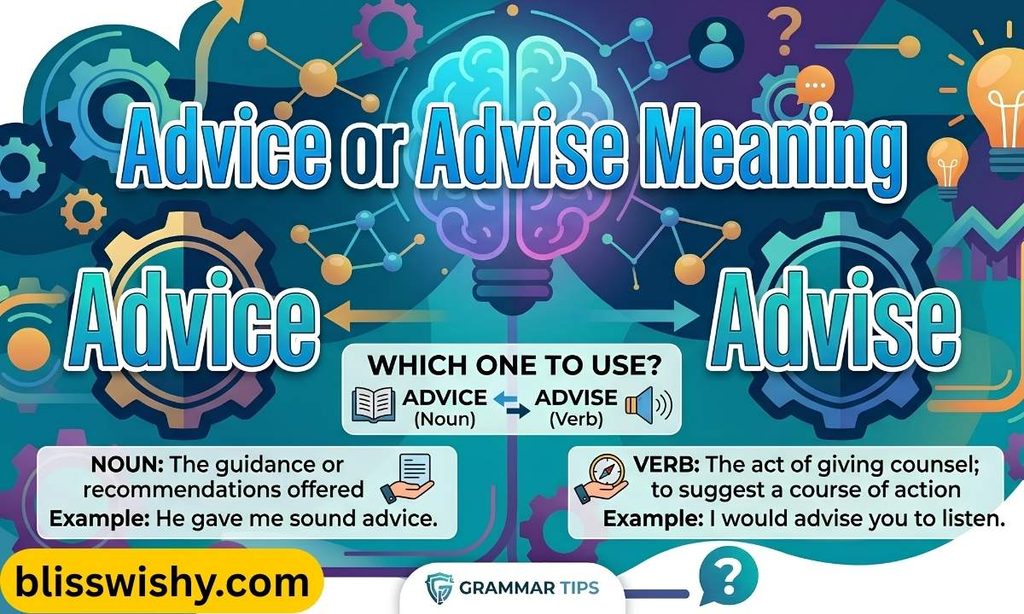
Advice means a suggestion or recommendation offered to help someone make a decision or handle a situation. Advise means the act of offering that suggestion or recommendation to someone. The core meaning behind both words is identical, guidance meant to help, but one names the guidance itself while the other names the act of giving it.
Advice is also what grammarians call an uncountable noun, meaning it never takes a plural form. You would never say “two advices,” even though you can say “two suggestions” or “two recommendations.” Instead, English uses phrases like “a piece of advice” or “some advice” to describe individual instances, which is a small but genuinely useful detail for anyone learning this word pair for the first time.
Comparison Table
| Feature | Advise | Advice |
| Part of speech | Verb | Noun |
| Pronunciation | Ends with a Z sound | Ends with an S sound |
| Example | I advise you to see a doctor. | Take my advice and see a doctor. |
| Can be pluralized | Not applicable | No, always uncountable |
| Common phrase | Please advise | Some helpful advice |
Which One to Use and When
Since these two words split cleanly along grammatical lines, picking the right one comes down to one simple question.
Use advise whenever you need a verb describing the act of recommending or guiding someone. Use advice whenever you need a noun naming the actual recommendation or guidance being discussed.
Simple Tip to Remember
Advice rhymes with “ice,” a noun you can hold, matching advice being a noun you can receive. Advise rhymes with “eyes,” and you use your eyes to actively observe and act, matching advise being an action word. If that feels like a stretch, just remember: C is for the calm, still noun, S is for the sliding, active verb.
Advise vs advice examples
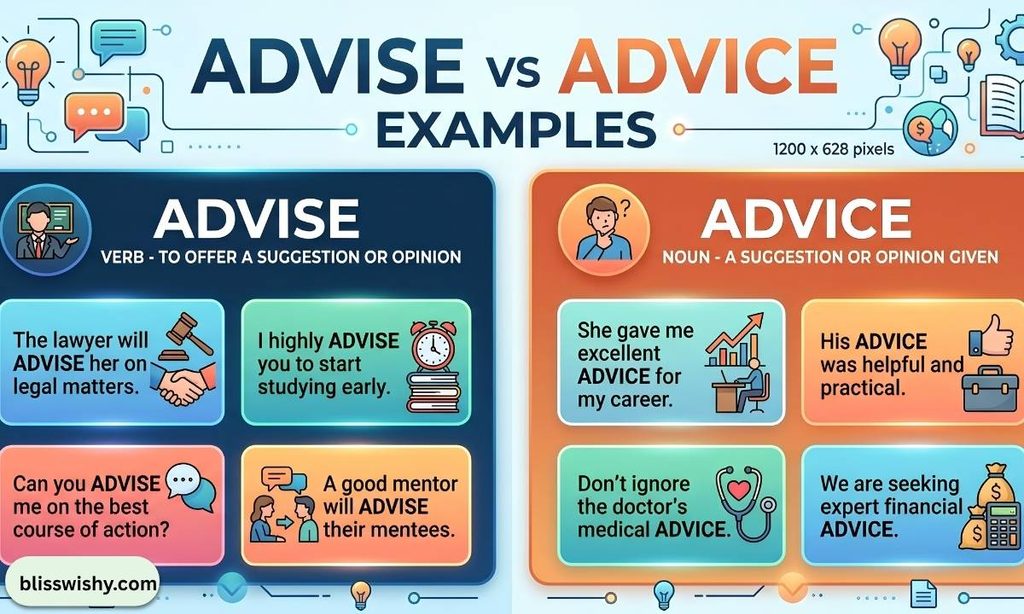
Seeing both words used correctly side by side locks the pattern in fast. “My accountant advised me to file early this year.” “My accountant’s advice was to file early this year.” Both sentences carry the same underlying message, but only one uses the verb form to describe the action of advising.
Common Mistakes People Make ” Advise or Advice “
Most people who mix these words up aren’t confused about the meaning, they’re just unsure which spelling matches which grammatical job.
1. Using “advice” as a verb
“Can you advice me on this?” is incorrect, since advice is a noun and can’t function as an action word in a sentence. The correct version is “can you advise me on this?” This particular mistake shows up constantly in professional emails and customer service messages, where the sender is rushing and doesn’t stop to check the grammar.
2. Using “advise” as a noun
“I need some advise” is incorrect, since advise can’t stand in as a thing being requested. The correct version is “I need some advice,” using the noun form instead. This error tends to happen when someone has recently used advise correctly as a verb and then carries that spelling into the next sentence out of habit.
3. Confusing pronunciation
Advise ends with a Z sound, while advice ends with an S sound, and mixing up the pronunciation in speech often leads directly to mixing up the spelling in writing, since people tend to spell words the way they say them. Practicing both words out loud, back to back, is a surprisingly effective way to train your ear to catch the difference before it ever reaches the page.
I need your advice or advise
The correct phrase here is “I need your advice,” since you’re asking for the noun, the actual guidance itself, not describing an action. “I need your advise” is a common mistake, but it breaks the basic noun versus verb rule this entire distinction is built on.
Advice or advise uk ” Advise or Advice “
British English follows this exact same distinction, advice as the noun and advise as the verb, with no regional variation between American and British usage here. This is different from word pairs like “practice” and “practise,” where British English does use separate spellings for noun and verb forms that American English collapses into one single spelling. Advise and advice stay consistent across every major English speaking region, including the US, UK, Canada, and Australia, which makes this one of the more reliable spelling rules in English since it never shifts depending on where the writing is published.
Everyday Real Life Examples ” Advise or Advice “
Seeing both words used naturally across different everyday situations makes the noun versus verb distinction far easier to remember.
In Emails ” Advise or Advice “
“Please advise on how you’d like to proceed with the contract before Friday.”
In School ” Advise or Advice “
“My guidance counselor gave me great advice about choosing a college major.”
On Social Media ” Advise or Advice “
“Does anyone have advice for surviving a long haul flight with a toddler?”
In Daily Life ” Advise or Advice “
“My grandmother always advised me to save at least ten percent of every paycheck.”
Please advice or advise
The correct business phrase is always “please advise,” never “please advice.” This shows up constantly in professional emails, and it’s one of the most commonly searched versions of this exact mistake, since “please advice” sounds nearly identical when spoken but breaks the grammar rule the moment it’s written down. “Please advise” works as a polite, slightly formal way of asking someone to respond with guidance or a decision, commonly used to close out a work email awaiting instructions, like “please advise on next steps” or “please advise how you’d like to move forward.”
Short Learning Section for Students ” Advise or Advice “
If the distinction still feels uncertain, breaking it into small steps makes it far easier to apply consistently.
Step 1: Learn the roles ” Advise or Advice “
Before worrying about spelling, decide whether your sentence needs an action word or a naming word. That single question resolves most of the confusion immediately.
Step 2: Practice ” Advise or Advice “
Write three sentences using advise as a verb, describing someone giving guidance, and three sentences using advice as a noun, naming the guidance itself.
Step 3: Use memory trick ” Advise or Advice “
Remember that advice, like “ice” or “device,” is a solid, held thing, a noun. Advise, like “revise” or “surprise,” describes an action, a verb.
Step 4: Check your sentence ” Advise or Advice “
Try substituting “recommend” into your sentence. If it still makes sense, you need advise. If it sounds wrong, try substituting “guidance” instead, and if that fits, you need advice.
Doctor advice or advise

The correct phrase is “doctor’s advice,” using the noun form to describe the guidance a doctor provides, as in “follow your doctor’s advice about medication timing.” If describing the action itself, you’d say “the doctor advised bed rest for a full week,” switching to the verb form since an action is being described.
Frequently Asked Question
Can you please advise or advice me?
The correct phrasing is “can you please advise me,” since advise is the verb needed to describe the action of giving guidance directly to a person. “Advice me” is never correct in standard English, regardless of context.
Can I give you some advice or advise?
The correct phrasing is “can I give you some advice,” since advice is the noun form needed here, naming the guidance being offered rather than describing an action. Swapping in advise would leave the sentence grammatically broken, since a verb can’t follow “some” the way a noun can.
Is it advice or advise in the UK?
Both British and American English follow the identical distinction, advice as the noun and advise as the verb, with no regional spelling differences for this particular word pair, unlike several other noun and verb pairs that do split by region.
What is an example of advice?
“Always read the contract before signing it” is a simple example of advice, a piece of guidance offered to help someone make a better decision. Advice can be as short as a single sentence or as detailed as a full conversation, but it always functions as the noun naming that guidance.
Conclusion
Advise and advice split cleanly along one simple line, action versus thing, verb versus noun. Once you connect advice to something you receive and advise to something someone actively does, the correct spelling becomes automatic, even in a fast moving email you don’t have time to second guess.

BlissWishy.com is a simple and friendly website created by James, dedicated to sharing heartfelt wishes, blessings, and meaningful messages for every special moment. From birthdays to daily inspiration, the site offers easy-to-read content that helps people express love, positivity, and joy in a thoughtful way.