
Typing a word and second guessing the ending, wondering if there’s an extra letter missing or one too many, happens more than people admit. You go to write about doing something by hand, or maybe you’re addressing someone by name, and suddenly you’re stuck between manuel or manual.
Here’s the short version: these are two completely different words, not a spelling error and a correction, and this guide breaks down exactly when each one belongs.
Quick Answer
Manual is an adjective or noun describing something done by hand or a book of instructions, as in “manual labor” or “read the manual.” Manuel is a proper name, a common Spanish, French, and Portuguese form of “Emmanuel,” used for people, not objects or actions. They aren’t interchangeable, and mixing them up usually comes down to a simple typing slip rather than genuine confusion about meaning.
Simple Background
Manual comes from the Latin word “manus,” meaning hand, which is also the root behind words like “manicure,” “manipulate,” and “manufacture.” It entered English through Old French in the 1300s, originally describing anything done using the hands rather than machinery. Over the following centuries, as industrial machinery became more common, “manual” picked up its contrasting meaning against “automatic,” a distinction that became especially important once factories and later automobiles gave people a real choice between hand operated and machine driven processes.
Manuel, by contrast, traces back to the Hebrew name “Immanuel,” meaning “God with us,” a name that appears in religious texts and spread into Spanish, French, Portuguese, and other Romance languages as a standard given name over the centuries. It remains one of the most common male first names across Spanish speaking countries today, similar to how common “Michael” or “David” are in English speaking regions. The two words share no linguistic connection at all, they just happen to look nearly identical on the page, which is really the entire source of the confusion.
Clear Explanation of the Difference
Since these words come from entirely different origins, the confusion really only exists because of how similar they look when typed quickly.
What is “Manual”?
Manual describes something operated or performed by hand rather than automatically, as in “a manual can opener,” or it refers to an instruction book, as in “the car’s owner’s manual.” It’s a common English word used constantly in everyday writing, technical documents, and casual conversation alike.
What is “Manuel”?
Manuel is a first name, common across Spanish, French, and Portuguese speaking cultures, and it’s the equivalent of “Emmanuel” in English. It refers to a specific person and functions grammatically as a proper noun, always capitalized regardless of where it appears in a sentence.
Manuel or manual car

This is one of the most common places this mix up shows up, since car shoppers and drivers talk about transmissions constantly. The correct phrase is always “manual car” or “manual transmission,” referring to a vehicle where the driver shifts gears by hand instead of relying on an automatic system. “Manuel car” isn’t a real phrase, it only makes sense if you’re specifically talking about a car that happens to belong to or be driven by someone named Manuel.
Manual transmissions have become less common in the US market over the past two decades, with automatic and semi automatic transmissions now dominating most new vehicle sales. That decline is actually part of why “manual” carries such a specific, recognizable meaning in car conversations today, since fewer drivers encounter the word in daily life outside of enthusiast communities, classic car forums, and used car listings that specifically highlight a manual option.
| Related Articles You’ll Love |
| https://blisswishy.com/bite-past-tense/ |
| https://blisswishy.com/eying-or-eyeing/ |
Comparison Table
| Feature | Manual | Manuel |
| Part of speech | Adjective or noun | Proper noun (name) |
| Meaning | By hand, or instruction book | A person’s first name |
| Origin | Latin “manus” (hand) | Hebrew “Immanuel” |
| Capitalized | Only at sentence start | Always capitalized |
| Common uses | Manual labor, user manual | Referring to a specific person |
| Interchangeable with the other | No | No |
Which One to Use and When
Since these words serve completely different purposes, picking the right one comes down to what you’re actually describing.
Use manual any time you’re describing something done by hand, operated without automation, or referring to an instruction booklet. Use Manuel only when you’re referring to an actual person who goes by that name, always with a capital M, since it’s a proper noun.
Simple Tip to Remember
Manual ends in “-al,” the same ending found in other hand related and instructional words like “annual” or “casual.” Manuel ends in “-el,” matching the ending of other names derived from Hebrew roots, like “Rachel” or “Daniel.” If you’re describing an action or object, reach for the “-al” ending.
Manuel or manual pdf
When searching for a document online, “manual pdf” almost always refers to an instruction guide saved as a PDF file, like a product manual or a user manual for equipment. “Manuel pdf” would only be correct if you were searching for a document specifically written by, about, or belonging to someone named Manuel, which is a far less common search intent than looking for an instruction guide.
Common Mistakes People Make
Most people who mix these two words up aren’t confused about their meanings. They’re just typing quickly and letting muscle memory take over.
1. Using “manuel” instead of “manual”
This is the most frequent version of the mistake, usually happening because “Manuel” is a more familiar word to type for people who know someone by that name, or because autocomplete suggests it first based on saved contacts or previous messages.
2. Thinking both words mean the same
Some writers genuinely assume manuel is just an alternate spelling of manual, similar to a regional spelling variant like “color” and “colour.” It isn’t, these are two unrelated words that happen to look alike, not two versions of the same word with a shared origin.
3. Spelling confusion
Because both words share five of their six letters, the eye can easily skim past a typo without catching it, especially in longer documents or fast typing sessions where proofreading gets skipped entirely.
4. Auto correct problems
Phone keyboards and some spell checkers occasionally auto correct “manual” to “Manuel” if the device has learned that name from your contacts or messages, which can insert the wrong word without you even noticing until after you’ve already sent something important.
Manual and Manuel definition
To put both definitions side by side clearly: manual, as an adjective, means operated by hand or without automatic assistance; as a noun, it means a book of instructions or reference information. Manuel is simply a proper name for a person, carrying no other definition beyond identifying someone by that name, the way “James” or “Maria” would.
Manuel vs manual meme
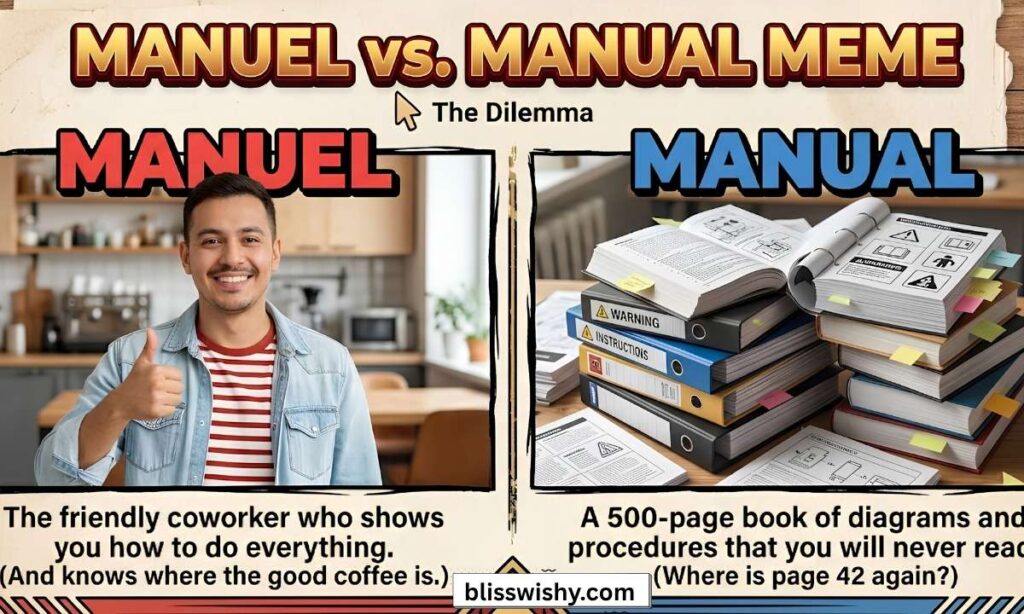
This search often comes from internet humor built around how similar these two words look, especially in screenshots of typos or autocorrect fails where “manual” accidentally became “Manuel” in an unexpected or funny context. There’s also a well known sitcom character named Manuel that occasionally gets referenced alongside these spelling jokes, adding another layer to why this comparison shows up in meme culture. Either way, the humor usually comes from the visual similarity between the two words rather than any real grammatical debate, and it’s a good reminder that even a single swapped letter can completely change what a sentence is trying to say.
Everyday Real Life Examples
Seeing both words used naturally across different contexts makes the distinction click much faster than a definition alone.
In Emails
“Please review the manual before installing the new software update on your workstation.”
In News
“Manuel Garcia, a local business owner, was recognized this week for his community volunteer work.”
On Social Media
“Just spent an hour trying to assemble this desk without reading the manual first, huge mistake.”
In Daily Life
“Can you grab the car manual out of the glove box? I need to check the tire pressure specs.”
Manual book meaning
“Manual” used as a standalone noun already means a book of instructions, so “manual book” is technically redundant, though it’s a common phrase in casual speech, especially among non native English speakers translating directly from languages where the equivalent phrase includes both words. In precise English, simply saying “the manual” or “the instruction manual” is the more natural, standard phrasing, and most style guides recommend dropping the redundant “book” entirely in formal or published writing.
Short Learning Section for Students
If the distinction between these two words still feels uncertain, breaking it into small steps makes it far easier to remember.
Step 1: Focus on meaning
Before worrying about spelling, ask whether your sentence needs a word describing an action or object, or a word identifying a specific person. That question alone eliminates most of the confusion immediately.
Step 2: Practice sentences
Write three sentences using manual correctly, describing objects or actions, and one sentence using Manuel correctly, referring to a person by name. Reading them back highlights how differently the two words actually function.
Step 3: Check spelling
Look closely at the ending of the word before finalizing any sentence: “-al” for manual, “-el” for Manuel. This single letter check resolves the vast majority of mix ups.
Step 4: Use memory trick
Remember that Manuel, like Daniel and Rachel, is a name ending in “-el.” Manual, like annual and casual, is a descriptive word ending in “-al.” Matching the ending pattern to the word’s category makes the correct choice almost automatic.
Manual instruction meaning
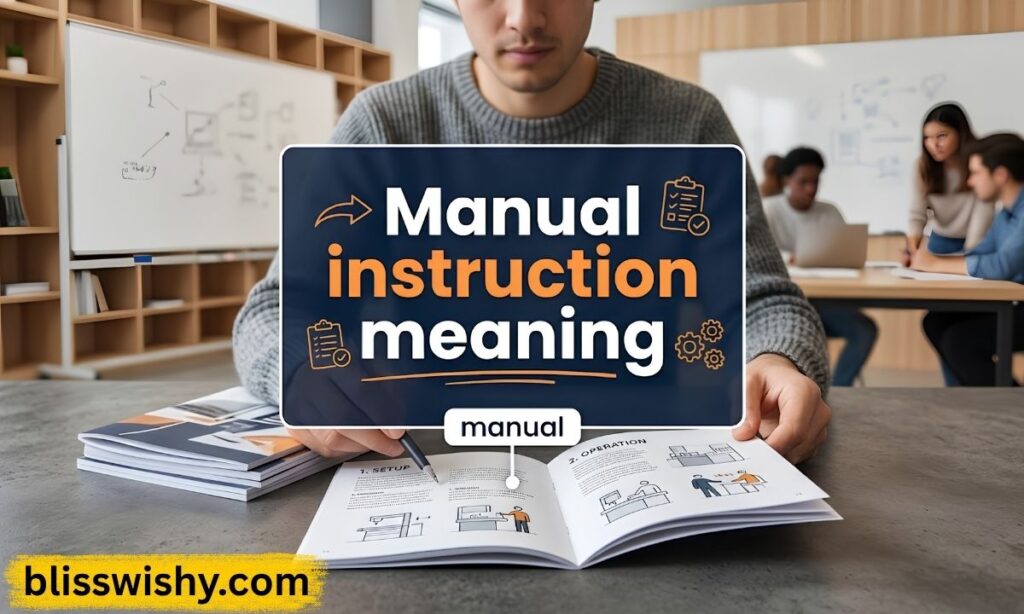
“Manual instructions” refers to step by step written guidance explaining how to use, assemble, or operate something, typically included with products, appliances, software, or equipment. The word “manual” here functions as an adjective describing the type of instructions, distinguishing them from automated help features like on screen prompts or voice assistants.
Frequently Asked Question
How do you spell manual as in a book?
It’s spelled M A N U A L, the same spelling used for the adjective meaning “by hand.” Context tells you which meaning applies, since English often uses one spelling for multiple related meanings, and readers rarely find this confusing once the surrounding sentence makes the intent clear.
What is the difference between manual and manuel?
Manual is a common English word meaning by hand or referring to an instruction book. Manuel is a proper name for a person, unrelated in origin or meaning, despite looking nearly identical in spelling. One is a description, the other identifies someone specific.
Does manual mean by hand?
Yes, as an adjective, manual specifically means done or operated by hand rather than by machine or automation, as in “manual labor” or “manual gear shifting.” It can also describe processes that require a person’s direct involvement rather than software or machinery handling the task automatically.
What is the difference between manual and manual?
This likely refers to the two separate meanings manual carries within the same spelling: as an adjective, it means by hand, and as a noun, it means an instruction book. Context in the sentence tells you which meaning is intended, even though the word itself never changes, spelling or otherwise.
Conclusion
Manual and Manuel are two entirely different words that just happen to share a striking resemblance on the page. One describes an action or an instruction book, and the other identifies a specific person by name. Once you connect the “-al” ending to actions and objects, and the “-el” ending to names, this mix up stops being something you have to think twice about.

BlissWishy.com is a simple and friendly website created by James, dedicated to sharing heartfelt wishes, blessings, and meaningful messages for every special moment. From birthdays to daily inspiration, the site offers easy-to-read content that helps people express love, positivity, and joy in a thoughtful way.








1 thought on “Manuel or Manual? Discover the Correct Spelling & Use”