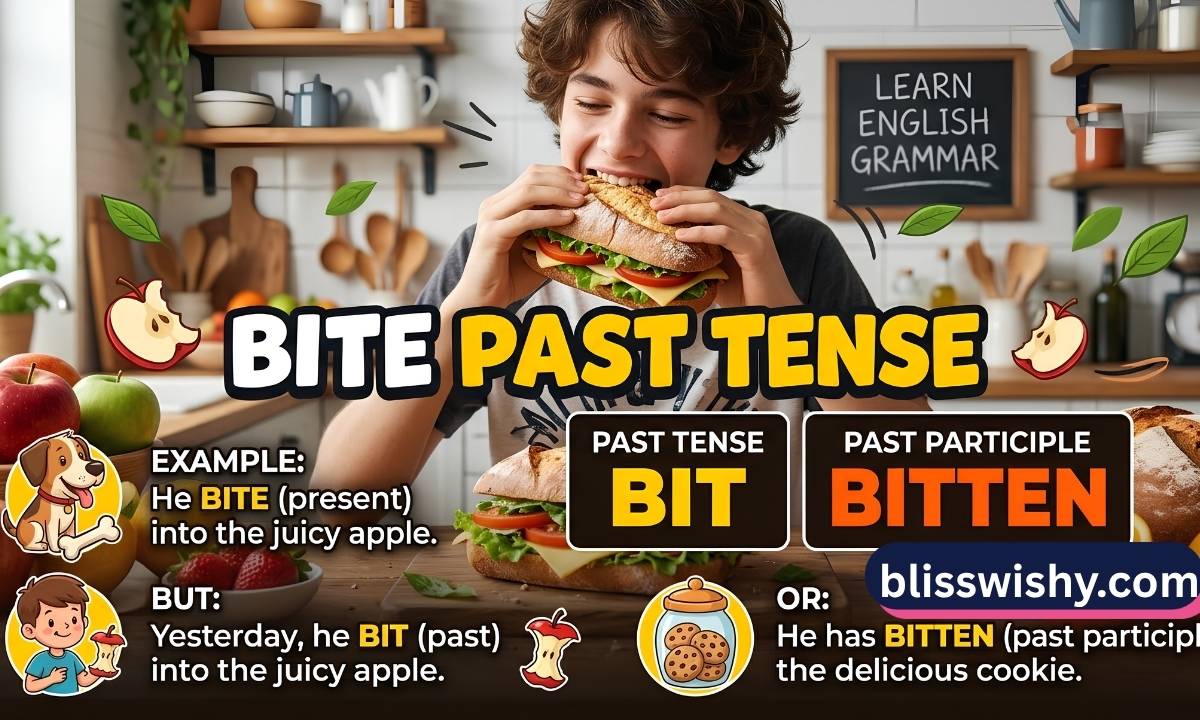
Typing out a sentence about something that already happened, then freezing because “bited” looks wrong but you’re not totally sure what the right word is, happens to more people than you’d think. Getting the bite past tense wrong is an easy mistake, since bite doesn’t follow the normal rules most English verbs use. Here’s the short answer:
the past tense is “bit,” and the past participle is “bitten,” and this guide breaks down exactly when to use each one.
Quick Answer
The past tense of “bite” is bit. The past participle, used with “has,” “have,” or “had,” is bitten. “The dog bit me yesterday” uses simple past tense, while “the dog has bitten three people this year” uses the past participle form.
Verb Forms
- Base form (present): bite
- Simple past: bit
- Past participle: bitten
- Present participle: biting
Bite past tense pronunciation
“Bit” is pronounced with a short I sound, like the word “sit” or “fit,” written phonetically as /bɪt/. This is different from “bite,” which uses a long I sound, like “kite” or “flight,” written as /baɪt/. Getting the pronunciation right actually helps with the spelling too, since hearing the short, clipped “bit” sound makes it easier to remember that the past tense drops the silent E and changes its vowel sound entirely.
bite past tense and past participle
These two forms confuse people because they look like they should be interchangeable, but they serve different jobs in a sentence. Bit stands alone as the simple past tense, describing something that happened and finished. Bitten always needs a helping verb like “has,” “have,” or “had” standing next to it, since it can’t function as a standalone past tense verb on its own.
Simple Background
Bite comes from Old English “bītan,” a strong verb that changed its internal vowel sound to show tense instead of adding a suffix like regular verbs do. This pattern, called ablaut, is the same reason “write” becomes “wrote” and “ride” becomes “rode.” Strong verbs like bite are some of the oldest surviving verb patterns in English, tracing back through Germanic languages for well over a thousand years, long before the “add -ed” rule became the default for newer or borrowed words entering English.
Linguists group bite with a handful of other verbs that follow a nearly identical vowel shift, including “hide” (hid, hidden), “slide” (slid), and “ride” (rode, ridden). Noticing that pattern can actually help you predict how other unfamiliar irregular verbs might behave, since English tends to recycle these old vowel shifting patterns across related verb families rather than inventing a brand new irregular form for every single word.
past tense of bite
To put it plainly, the past tense of bite is bit, full stop. “I bit into the apple and immediately regretted it” and “the mosquito bit her three times last night” both use this same simple past form, regardless of who or what is doing the biting.
Clear Explanation of the Difference
Bite, bit, and bitten each serve a specific grammatical role, and mixing them up is the single biggest mistake people make with this verb.
What is “Bite”?
Bite is the base form, used for present tense and infinitive constructions. “Dogs sometimes bite when they feel threatened” and “I don’t want to bite off more than I can chew” both use the base form, since neither sentence describes a completed past action.
Bite past tense sentence
Seeing bit used correctly in full sentences makes the rule stick faster than any definition alone. “She bit her tongue during the meeting instead of arguing with her boss.” “The snake bit the hiker near the trailhead, and he needed medical attention within the hour.” Both sentences describe a completed action in the past, which is exactly when bit is the correct choice.
bite past form
Bit and bitten are the two forms that cover everything happening in the past tense, but they aren’t interchangeable, and knowing which one fits where matters for sounding grammatically correct.
What is “Bit”?
Bit is the simple past tense, standing alone without any helping verb. “He bit into the sandwich before realizing it was someone else’s lunch.” Bit works exactly like “walked” or “jumped” in terms of sentence structure, even though it doesn’t follow the same “-ed” spelling pattern.
What is “Bitten”?
Bitten is the past participle, always paired with a helping verb like has, have, or had, or used in passive voice constructions. “She has been bitten by mosquitoes all summer” and “I had never been bitten by a dog before that incident” both rely on bitten alongside a form of “have” or “be.”
Dog bite past tense
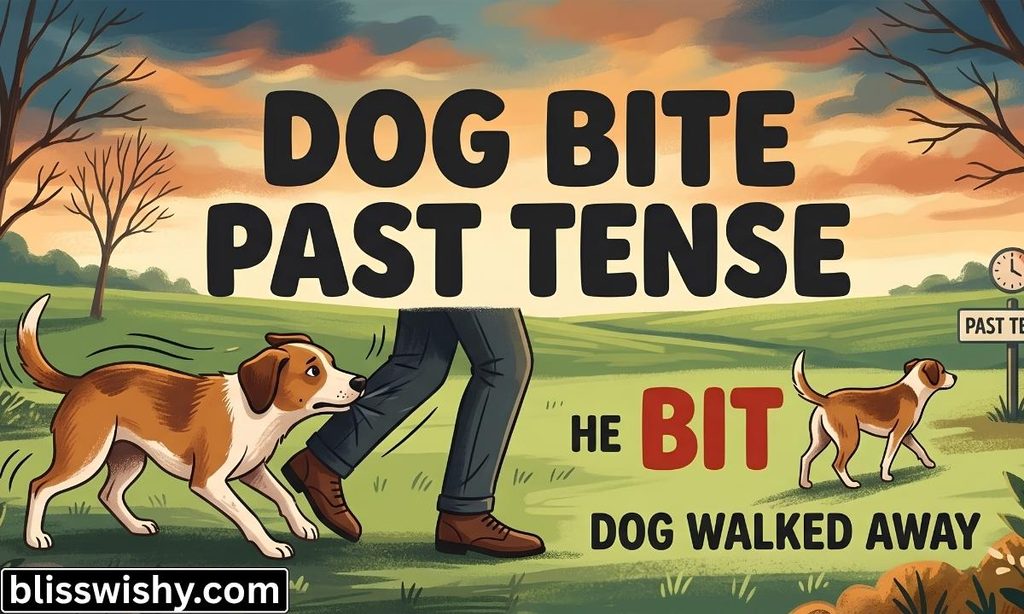
This is one of the most commonly searched real world examples of this grammar question, and for good reason, since dog bite incidents get discussed and reported constantly. “The dog bit the mail carrier on Tuesday” uses simple past tense, appropriate for a direct, active statement of what happened. “The mail carrier was bitten by the dog on Tuesday” uses the passive voice with bitten instead, which shifts the sentence’s focus onto the person who got bitten rather than the dog doing the biting.
| More Helpful Articles |
| https://blisswishy.com/ts-meaning/ |
| https://blisswishy.com/sfs-meaning/ |
bite verb forms
Bite belongs to a small but very common group of English irregular verbs where all three principal forms look completely different from one another: bite, bit, bitten. This is actually rarer than you might expect, since many irregular verbs share at least one form between two of their three principal parts, like “run, ran, run.” Bite keeps all three forms fully distinct, which is part of why it trips up both native speakers and English learners alike.
Comparison Table
| Form | Word | Example Sentence |
| Base form | Bite | Please don’t bite your nails during the interview. |
| Simple past | Bit | She bit into the pizza before it had cooled down. |
| Past participle | Bitten | He has been bitten by fire ants twice this summer. |
| Present participle | Biting | The puppy keeps biting the furniture legs. |
| Incorrect form | Bited | Never correct in any context. |
Which One to Use and When
Picking the right form gets easy once you know exactly what job each word is doing in your sentence.
Use bite for present tense or general statements, like “mosquitoes bite more at dusk.” Use bit for a completed action in simple past tense, standing on its own without any helping verb. Use bitten only when it’s paired with has, have, had, was, or were, since it can never work as a standalone past tense verb by itself.
Simple Tip to Remember
If you can swap in “has” or “have” right before the word and the sentence still sounds natural, you need bitten. If the sentence sounds complete without any helping verb at all, you need bit.
Bite past perfect tense
The past perfect form uses “had” plus bitten, describing an action that happened before another past action. “By the time the vet arrived, the dog had already bitten two people at the park.” This structure shows a clear sequence of past events, with the biting happening first, before the vet’s arrival, which is exactly what past perfect tense is built to communicate.
Common Mistakes People Make
Most errors with this verb come from applying rules that work perfectly fine for other, more common verbs, just not this one.
1. Saying “bited”
This is the most frequent mistake, and it happens because most English verbs simply add “-ed” for past tense. Bite is irregular, so “bited” never appears in any standard dictionary, no matter how natural it might feel to type, especially for English learners coming from languages with more consistent verb conjugation rules.
2. Using “bit” instead of “bitten”
“I have bit my nails since childhood” is a common error, since bit can’t follow “have” or “has.” The correct version is “I have bitten my nails since childhood,” even though bit feels shorter and more familiar in casual speech. This mistake shows up constantly in spoken English, where the grammar rule often gets overlooked in the moment, even by confident, fluent speakers.
Bite future tense
The future tense simply pairs “will” with the base form, giving you “will bite.” “The dentist warned me that the tooth might bite down oddly until the filling settles.” No irregular forms come into play here, since future tense in English doesn’t change the verb itself, it just adds “will” or “going to” in front of the base form.
bite simple past tense
To reinforce the core rule one more time, simple past tense always means bit, never bited, and never bitten standing alone. “The fish bit the lure within seconds of casting the line” is a clean, correct example of simple past tense doing exactly what it’s supposed to do.
3. Mixing up past tense and past participle
Writers sometimes flip the two entirely backwards, writing “I have bit” or “I bitten the apple,” both of which are incorrect. Bit stands alone, bitten needs a helping verb, and swapping that rule in either direction breaks the sentence.
Bite verb forms V1 V2 V3
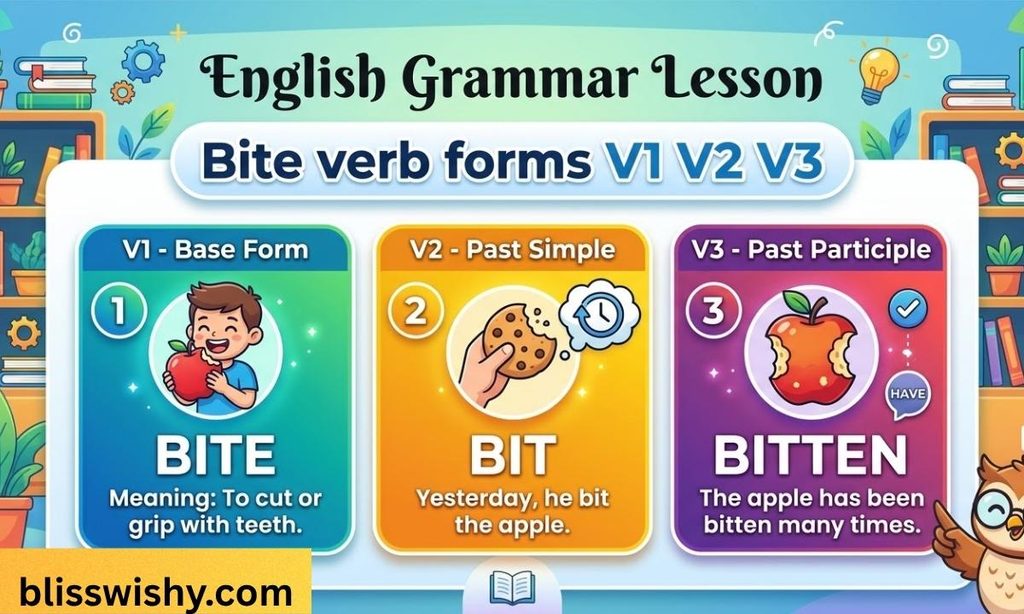
In grammar terminology, V1 refers to the base form, V2 to the simple past, and V3 to the past participle. For bite, that breaks down as V1: bite, V2: bit, V3: bitten. Some grammar frameworks extend this further to V4, the present participle (biting), and V5, the third person singular present form (bites), giving you a complete five form breakdown of this one irregular verb.
Everyday Real Life Examples
Seeing bite, bit, and bitten used naturally across different situations locks the pattern in far better than a textbook chart ever could.
In Daily Life
“I bit my lip so hard during the scary movie that it actually hurt afterward.”
At Home
“The cat has bitten the couch cushion so many times we finally just bought a new one.”
Outdoors
“A horsefly bit my arm twice while I was setting up the tent.”
In Stories
“The wolf had bitten through the rope hours before the hunters ever found the trap.”
Short Learning Section for Students
Breaking this irregular verb down into small, repeatable steps makes it far easier to remember under pressure, like during a test or a fast conversation.
Step 1: Learn the forms
Memorize all three principal parts together as a set: bite, bit, bitten. Reciting them in that exact order, the same way you’d learn a times table, builds the pattern into memory faster than learning each form separately.
Step 2: Practice
Write five original sentences, one using bite, two using bit, and two using bitten with a helping verb. Reading them back out loud afterward catches mistakes your eyes might otherwise skip past.
Step 3: Use a memory trick
Picture a timeline: bite happens now, bit happened once and finished, bitten needs a partner word like has or had standing next to it to make sense.
Step 4: Watch for “has” and “have”
Whenever you see has, have, or had directly before a verb, that’s your signal the sentence needs bitten, not bit. This single check catches the majority of mistakes people make with this word.
Frequently Asked Question
Is it bitten or bit?
Both are correct, depending on the sentence. Use bit as a standalone simple past tense verb, and use bitten only alongside a helping verb like has, have, had, was, or were, never on its own.
What is the V1, V2, V3, V4, V5 of bite?
V1 is bite, V2 is bit, V3 is bitten, V4 (present participle) is biting, and V5 (third person singular present) is bites. Most grammar guides focus on the first three, since those are the principal parts that define an irregular verb, but all five forms are genuinely useful to know for building complete sentences.
Is it bite me or bit me?
“Bite me” is a present tense command or casual expression, like a playful retort. “Bit me” is simple past tense, describing something that already happened, like “the dog bit me yesterday.” Context makes the difference obvious almost every time.
Is it biting or bitting?
Biting is correct, with a single T, since bite already ends in a silent E that gets dropped before adding “ing.” “Bitting” is not a standard English word and is simply a misspelling that occasionally slips through in fast, casual typing.
Conclusion
Bite, bit, and bitten each have a clear job to do, and once you connect bit to standalone past action and bitten to sentences with has, have, or had, the confusion clears up for good. This irregular verb has been shifting its vowel sound the same way for well over a thousand years, so getting it right puts you in good company with just about every native English speaker who ever second guessed it first.

BlissWishy.com is a simple and friendly website created by James, dedicated to sharing heartfelt wishes, blessings, and meaningful messages for every special moment. From birthdays to daily inspiration, the site offers easy-to-read content that helps people express love, positivity, and joy in a thoughtful way.





2 thoughts on “Bite Past Tense: Learn the Correct Form Fast”